


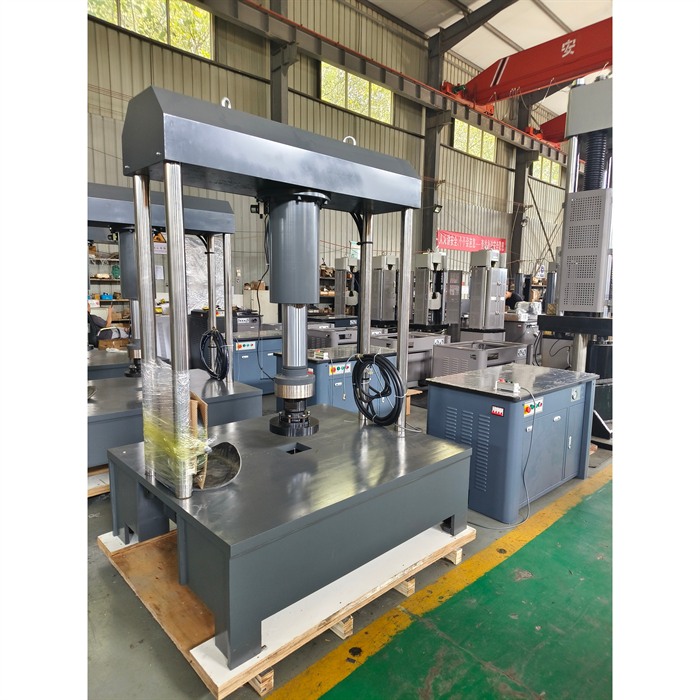
KASON HYJ-106Wis a computer control manhole cover compression testing machine, one of themanhole cover compression test machinesbuilt by KASON. It presses down on the centre of a cover, holds the load, and records what the cover does while it is loaded. That single sequence is what a road authority, a utility or a precast yard needs in order to show that a cover can carry its traffic class and still seat properly afterwards.
Key Takeaways
- The loading cylinder is mounted above the specimen, so a cover or grating is placed on the table and Tested without being lifted into a frame.
- A gimbal joint between the piston and the pressure pad keeps the load square to the cover face even when the casting is not perfectly flat, which is what protects the accuracy of the reading.
- Control modes cover constant stress, constant force and force hold, and the software draws force-time, force-deflection and deformation-time curves while the test runs.
- Cyclic loading, loading speed and the loading waveform can be programmed on site, so a repeated load sequence taken from a standard becomes an automatic routine rather than a manual procedure.
- Overload protection unloads or stops the machine automatically, and the failure load and the deformation are collected and printed without manual transcription.
What the HYJ-106W Is Built For
The machine tests the load bearing capacity and the deformation of manhole covers and similar flat castings. It covers the cover materials that appear in a modern specification: cast iron, recycled resin composite, polymer matrix composite and steel fibre concrete. It is also used for gratings, frames and other heavy flat specimens where the question is simply how much vertical load the part takes and how far it moves under that load.
Loading From Above: Why the Cylinder Points Upward
Most presses make the operator lift the specimen under a fixed head. This machine reverses the arrangement: the hydraulic cylinder sits above the work table and pushes down, so a cover is set down flat and tested in place. The main frame is a high-rigidity structure with four columns carrying the reaction, which keeps frame deflection out of the measured deformation. Where the piston meets the pressure pad there is a ball-jointed connection; the pad therefore settles onto the cover face and loads it evenly instead of digging into a high point, which matters most on a casting whose face is slightly dished.
Hydraulics Kept Clean and Quiet
The cylinder and piston run on special seals chosen for high sealing performance, low friction and long life, so the loading ram does not lose force to internal leakage as the seal wears. The pump and motor unit is a Testing-machine grade assembly rather than a general industrial pump set, which keeps the noise down and the service life up, and an ultra-precision oil filter keeps the oil system clean so the control actuators keep working over years of operation rather than months.
Software: Curves, Reports and Programmable Load Cycles
The computer controller displays the current force, the peak force and the test progress while the run is in progress, and it samples fast enough to record the curve rather than a series of points. Control modes include constant stress, constant force and force hold, and the test curves cover force against time, force against deflection and deformation against time, with smooth transitions between modes. Because the closed loop can be programmed on site, a cyclic loading pattern, a loading speed and a loading waveform taken from a standard become an automatic sequence: each step of the procedure is entered once and the machine then runs the whole test without an operator standing over it. An automatic force reset removes the human error that comes from reading a dial, overload protection unloads or stops the test if force or displacement goes beyond the rated value, and the result is printed automatically with the failure load and the deformation values. A report editing tool is included for laying out curves and values in the format a laboratory or a client expects.
Standards and Applications Covered
The three standards below are the ones most often named in an international manhole cover specification, and each of them puts the load squarely on the cover while its deflection is watched:
- EN 124-1, the general framework for gully tops and manhole tops in vehicular and pedestrian areas, including the load bearing capacity test and the permanent set requirement
- EN 124-2, which applies that same framework to cast iron manhole tops and frames
- ASTM C478/C478M, the specification for circular precast reinforced concrete manhole sections, whose concrete quality is verified by compression testing
The machine family that includes this model was designed around the cast iron, recycled resin composite, polymer matrix composite and steel fibre concrete cover standards used in its home market, and the same frame is offered in a hinged version for covers that open on a hinge and in a lighter digital display version for routine production checks. Because the load is measured by a load sensor and the deflection is measured electronically rather than by a dial gauge, the numbers are traceable and can support third-party inspection rather than only internal screening.
Frequently Asked Questions
1. Can the machine test a cover together with its frame?
Yes. The pressure pad comes down on the cover seated in its frame, which is how the load bearing capacity test is normally run; frames and gratings can also be loaded directly. The work table is large enough to take the assembly, and the loading pad is sized to suit standard and European style covers.
2. How is the load kept square on an uneven casting?
The pressure pad is connected to the piston through a ball joint, so the pad tilts to match the cover face and loads it uniformly instead of concentrating force on one edge. That is what makes the measured load comparable between a new cover and one that has been in service.
3. What happens if a test goes beyond the machine rating?
Overload protection unloads or stops the test automatically when force or displacement exceeds the rated value, so neither the frame nor the load sensor is damaged by a wrong set-up or by an unexpectedly strong cover.
4. Can a repeatable load cycle be run without an operator?
Yes. The closed loop controller accepts a programmed sequence covering cyclic loading, loading speed and loading waveform, and it can step through each stage of a standard procedure automatically. The run then repeats identically for every cover in the batch.
5. Where does this machine sit in the KASON range?
Alongside thecomputer control hydraulic manhole cover compression testing machines, thehinged manhole cover compression testing machinefor hinged covers, and thepipe ring expansion test machinesfor the rest of the buried infrastructure programme.
Contact me if you are interested!
Email: admin@jnkason.com
Whatsapp: +86 15910081986